01 / PROMISE
Brand Promise
What the organisation commits to deliver—and the meaning people attach to that commitment.
The Genesis Triad® is a framework for seeing the connection between what an organisation promises, what people experience and what its communication reinforces. It is built for AI-enabled workflows, where greater speed makes alignment more—not less—important.
A capable team can build a good product, create a credible brand and run effective marketing—and still lose trust. The problem often sits between those functions: a promise the experience cannot uphold, an experience the message does not explain, or a message that accelerates the wrong expectation.
What the organisation commits to deliver—and the meaning people attach to that commitment.
What people actually encounter across the relationship, from first contact to continued use.
How expectations are created, evidence is shared and the right people recognise relevance.
AI can help teams synthesise research, recognise patterns, develop hypotheses, explore alternatives and improve existing processes. The Genesis Triad keeps that capability connected to a clear promise, a human need and truthful market communication.
It can connect signals across Brand, Human Experience and Marketing that separate workflows may miss.
Shared intent and evidence help teams decide where AI adds value—and where speed would only amplify drift.
People define the purpose, validate the meaning and remain accountable for decisions and consequences.
Practical examples demonstrate how AI can strengthen implementation and improve existing processes without replacing human responsibility.
Each decision may look reasonable on its own. The pattern only becomes visible when the system is seen together.
The organisation says one thing, while priorities and delivery quietly move elsewhere.
People encounter friction, confusion or indifference where the promise implied ease, confidence or care.
Marketing amplifies a story the product and organisation are not yet ready to prove.
Teams optimise their own outputs without a shared view of what the whole must protect.
The Genesis Triad gives founders and cross-functional leaders a shared way to talk about the business they are building—before speed turns small contradictions into structural ones.
Holding vision, product, people and market expectations together as the business changes.
Connecting strategic intent with the real human experience of using and adopting the product.
Replacing competing definitions with one language for promise, experience and communication.
“The Genesis Triad isn’t a shortcut. It’s a compass.”
Felix Chandran G — architect of the framework
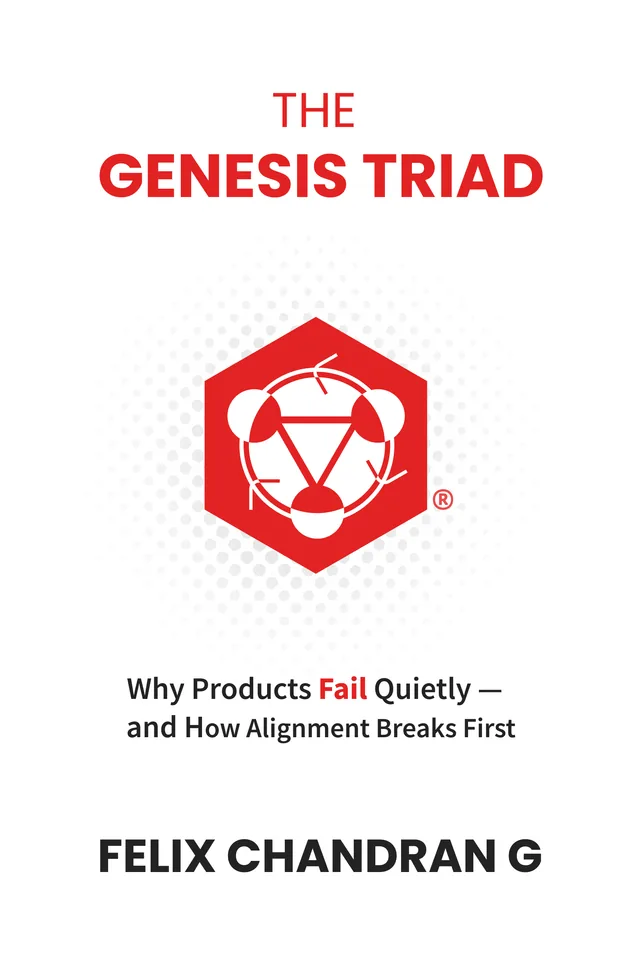
The book moves from the foundations of Brand, Human Experience and Marketing to the diagnostic thinking, practical tools and AI-aware operating model that bring the framework to life.
Visit the book page →